
* Different than original stories, those speculations made by dialogs with AI ; Based on researchs you can find in Archive.


Seeds of
Utopia:
Speculating Decentralized Agricultural
Futures from
River to the Sea
We are living through an age of ruin and reckoning.
The earth burns, rivers dry, and food systems—once communal, organic, cyclical—have been transformed into instruments of extraction and control. Yet while these crises unfold globally, no place reveals the violence of dispossession more starkly than Palestine. There, under the shadow of apartheid and military occupation, the destruction of land is not collateral—it is the strategy. Olive trees uprooted. Water siphoned. Fields razed to dust.
What we see in Palestine is not just a war on people, but a war on land itself—on the ancient and intimate relationship between people, soil, and sovereignty.
In the face of this devastation, the vision must be bolder than ever.
This speculative design asks: What would it mean to reclaim the future of food through decentralized, self-governing agricultural colonies?
What if we reimagined agriculture not just as survival, but as a radical act of autonomy, rooted in justice and fueled by technologies that are meant to serve people, not exploit them?


The Broken System We Inherit
The colonial blueprint—whether in Palestine, Anatolia, or across the Global South—has always revolved around land theft, monoculture, and the erasure of indigenous knowledge. Industrial agriculture, shaped by neoliberalism, financialization, and corporate monopolies, turns living systems into profit streams: seeds patented, soil poisoned, farmers dispossessed. Palestine stands as a brutal mirror: a place where agriculture is both a site of livelihood and a frontline of resistance. Each uprooted olive tree is a reminder that food is power—and that colonialism thrives on severing people from their land.


Speculating New Commons: Decentralized Agricultural Colony
In this imagined future, agricultural colonies across the Middle East, Anatolia, and the Mediterranean rise not as isolated pockets, but as a network of autonomous communities—rooted in local knowledge, yet interconnected by digital infrastructures that ensure transparency, equity, and resilience.
Each colony operates as a DAO (Decentralized Autonomous Organization): decisions about land use, crop rotation, water sharing, and energy distribution are made collectively, recorded immutably on a blockchain. This ensures true local governance—free from state capture or corporate seizure. AI tools help monitor soil health, predict ecological shifts, and fine-tune regenerative practices, but these technologies remain servants, never masters.
Markets are rebuilt peer-to-peer. Surplus food moves through blockchain-powered cooperatives, bypassing middlemen, returning value directly to farmers. Tokenized economies reward not just yield but ecological stewardship: the more a community regenerates its soil, preserves biodiversity, and restores degraded land, the stronger its standing within the network.
Land is de-financialized. No longer a speculative asset, it becomes a commons—digitally protected through decentralized ledgers, held collectively, and cultivated as a shared lifeline. Renewable energy—solar, wind, microgrids—powers these colonies, ensuring energy sovereignty alongside food sovereignty.


The Challenge:
Between Tool and Weapon
And yet—this vision cannot be naive. Blockchain, Ethereum, DAOs: these are tools, not salvation. Shitty Web3, much of this space remains colonized by elites—flush with capital, blind to histories of dispossession, and often disinterested in the true radical potential of their own creations. The technology is there; but its promises remain, so often, trapped in boardrooms, not blooming in fields. So we leave this essay open-ended, with a challenge. What happens if these tools—meant for decentralization, meant for liberation—finally slip from the grasp of the privileged and reach the mountains, fields, and seas? What if those who have been dispossessed, displaced, and disinherited become the new architects—not only of food systems, but of governance, of commons, of future worlds? Will the stewards of this technology stand aside—or stand in the way? The seeds are planted. Now we wait to see who will water them—and who will try to burn them down.


Terra Pact
A Speculative Study
of a
Decentralized Colony
In this speculative research essay, we explore a Terra Pact colony operating across Anatolia, the Middle East, and the Mediterranean. This imagined network of communities is grassroots, decentralized, anti-elite, and culturally rooted, aligning with a decolonial Global South ethos.
The study covers five key dimensions of the colony’s design and operations:
→ Governance: How decentralized autonomous organizations (DAOs), consensus methods, and conflict resolution uphold local autonomy and federated unity.
→ Agricultural Technologies: How regenerative farming and advanced tech (AI, IoT) combine to heal land and sustain communities.
→ Communication Infrastructure: How decentralized mesh networks and peer-to-peer tools enable resilient connectivity under potential repression.
→ Tokenomics: How a multi-token system (labor, governance, regenerative credits) and mutual credit facilitate a solidarity economy across colonies.
→ Cultural Practices: How decolonial rituals, seasonal assemblies, storytelling, and solidarity actions knit together a shared culture and purpose.
Throughout, the design remains open-ended, posing questions about future directions rather than offering utopian tech fixes. The following sections present each aspect in detail, accompanied by visual aids and narrative examples.
Governance in the Terra Pact Colony
At the heart of the Terra Pact colony’s governance is a network of interlinked DAOs (Decentralized Autonomous Organizations) that operate at local, regional, and global scales. Each local community (village or urban commune) runs a Colony DAO to make decisions about its own affairs. These local DAOs then send delegates or proposals to a Regional Cluster DAO, which coordinates initiatives across a bioregion (e.g., Anatolia & Mesopotamia, or the Mediterranean basin). Finally, regional clusters link into a Global Terra Pact Assembly, forming a mesh of shared governance across the entire Terra Pact network. This structure reflects Elinor Ostrom’s principle of nested governance, where responsibility is “built in nested tiers from the lowest level up to the entire interconnected system” . It ensures decisions are made at the most local level possible while enabling large-scale coordination when needed.

Local Colony DAOs (rectangles) govern day-to-day matters in villages or neighborhoods. Multiple local DAOs form a Regional Cluster (ovals) that handles issues spanning a wider area (e.g., watershed, province). These clusters are connected through the Global Terra Pact Assembly (green oval), a federated council where delegates from each region convene.
This nested structure allows polycentric governance – power is distributed and decisions emerge from multiple centers rather than a top-down hierarchy. Each level has clearly defined scope but remains accountable to the levels above and below (in line with Ostrom’s designs for commons governance ).
For example, a water-sharing agreement might be settled in a Regional DAO (since rivers flow across villages), whereas a local dispute over land use stays in the local DAO. The global assembly coordinates principles, inter-region solidarity, and external relations, without dictating local specifics.
Decision-Making Processes: Within each DAO, the Terra Pact colony emphasizes inclusive and collaborative decision methods. They draw from sociocracy and liquid democracy rather than simple majority voting. In sociocracy-style consent decision-making, proposals are adopted if no member has a paramount objection, rather than requiring everyone’s enthusiastic agreement.
In other words, “in consensus, we ask everyone ‘Do you agree?’. In consent, we ask ‘Do you object?’” . This subtle shift allows the community to move forward unless a proposal would cause harm, greatly expanding the “range of tolerance” for decisions.
Meetings are often structured as rounds: a proposal presentation, clarifying questions, reaction round, and then a consent round asking for objections. If objections arise, they are addressed through amendments or integrations, treating them as valuable information rather than hindrances. This approach prevents tyranny of the majority and also avoids the paralysis of requiring unanimous full agreement – it’s a pragmatic middle path that fosters equivalence (everyone’s voice matters) and efficiency.
Liquid democracy complements this by allowing flexible delegation of votes. Community members vote directly on many issues, but can also delegate their voting power to a trusted peer for topics where they feel less confident.
Delegation is transitive and revocable: one can choose a proxy for agricultural matters, another proxy for tech issues, and take back one’s vote anytime. This dynamic representation means expertise circulates: e.g., a water engineer’s vote may carry weight on irrigation proposals via others delegating to them. It also prevents ossified leadership – delegates gain influence only so long as others trust them, aligning with the colony’s anti-elitist ethos.
Role Rotation and Accountability: To avoid concentration of power, important governance roles are rotated regularly. For instance, facilitation of meetings, note-keeping, treasury oversight, and conflict mediation roles might shift every few months, or cycle through representatives of different demographics (youth, elders, different gender identities).
This rotation ensures no single person or clique holds a gatekeeping position indefinitely, keeping governance grassroots. Roles are also often doubled up with a “champion and deputy” model – one primary role-holder and a secondary who can step in and assist. This not only provides backups, it also trains new people into roles continually. The DAO’s smart contracts might enforce term limits or trigger elections for roles on a schedule (e.g., quarterly election of a “Coordination Circle” or renewal of delegates).


Transparency is key: open ledgers and community dashboards show each role’s current holder, their term, and their performance (with community feedback or rating mechanisms). This way, leadership is seen as a temporary service role, not a position of personal privilege.
Conflict Resolution: Despite a shared vision, conflicts and tensions inevitably arise – be it interpersonal frictions, disputes over resource allocation, or differing ideas between localities.
The Terra Pact colony institutes restorative and sociocratic conflict resolution processes. Each local DAO has a Conflict Resolution Circle or committee trained in mediation and nonviolent communication. When a dispute emerges, this circle convenes a restorative circle bringing together the parties in conflict with a neutral mediator and community observers. The focus is on dialogue: each side shares their perspective and impact, then the group works toward a resolution or “restorative agreement”.
Solutions might include apologies, changes in behavior, community service, or policy adjustments, aiming to repair relationships rather than punish. For serious issues, the colony also borrows from indigenous and decolonial practices: for example, a council of elders (respected longtime members, including women and minority voices) may be called to give guidance or arbitrate on matters threatening community cohesion. This echoes practices in many Middle Eastern and Anatolian villages where elders mediate local conflicts, but now integrated with a modern horizontal ethos (elders have moral authority but decisions still need consent of those involved).
If a conflict cannot be resolved locally (say a dispute between two different local colonies, or a local council accused of violating Pact principles), it can escalate to the Regional DAO’s conflict council. Here, delegates from neighboring communities form a jury or mediation panel. Because they are a step removed, they can often see the bigger picture and propose creative compromises. In worst-case scenarios, the Global Assembly might convene a conflict tribunal for issues affecting the whole Pact (for example, if one region’s practices are claimed to undermine shared environmental goals or human rights). However, this is rare – the emphasis is on subsidiarity (handling problems at the lowest competent level).
The global body mostly issues guiding principles (a kind of evolving constitution co-created by all members) which local groups voluntarily internalize. Enforcement is social and reputational: a colony that consistently violates Terra Pact values would lose trust and could be symbolically “shunned” by others (e.g. losing access to mutual credit or technical help) until they reconcile. These community-enforced norms replace the need for any centralized coercive authority.
Checks and Balances: The governance design deliberately prevents both tyranny and apathy. Power-sharing mechanisms include: rotating roles, delegated voting with instant recall (liquid democracy), multi-layer federated decision-making, open transparency of finances and decisions (all proposals and votes are recorded on a public ledger for accountability), and a culture of continuous feedback. For example, every major decision might undergo a “retrospective” after 3 months – the community evaluates if the decision’s outcome met the intended aim or if adjustments are needed.
This learning loop ensures policies remain adaptive rather than rigid. In addition, borrowing from Ostrom’s principles for commons, the colony has graduated sanctions for bad actors: minor first-time offenses (like not fulfilling an agreed task) may just get a friendly reminder; repeated or serious issues (like misusing community funds) trigger more formal responses (temporary loss of decision rights, required restitution, etc.), always with a path to restoration through contribution and dialogue.
Overall, Terra Pact’s governance is an experimental fusion of blockchain DAO tools with sociocratic values and indigenous wisdom. It is both highly structured (with defined circles, processes, and tech infrastructure) and inherently flexible (all rules can be changed by collective agreement, and continuous evolution is built in). The true test of this governance model is not in the absence of conflict, but in the colony’s ability to address problems collectively without reverting to hierarchy or violence.
The design remains anti-elite: even the global assembly is not a top-down government but a convening space for the network to coordinate.
Like a mycelial network of fungi or the root systems of a forest, intelligence is distributed and emergent. It is a living system of governance that can grow, adapt, and regenerate as the colony does.
Regenerative Agricultural Technologies
The Terra Pact colony’s livelihood and sustenance are deeply tied to the land – from Anatolian plateaus to Mediterranean coasts. They practice regenerative agriculture not just as a technique but as a way of life. Farmlands are treated as commons, and farming blends traditional agroecological knowledge with cutting-edge technology for monitoring and optimization.
The goal: produce abundant, healthy food while healing ecosystems, sequestering carbon, and increasing resilience to climate change. Permaculture Design and Land Use: Each colony’s site is designed using permaculture principles – observing and mimicking natural ecosystems. Farms integrate polycultures (multiple crops and trees grown together), agroforestry (food forests, windbreaks of native trees), water catchment systems (swales, ponds, rain gardens to harvest rainwater), and rotational grazing of animals. For example, a Terra Pact village in Anatolia might cultivate a food forest of olives, figs, and pomegranates mixed with nitrogen-fixing shrubs and medicinal herbs underfoot, while chickens roam the understory to control pests. Fields are never left bare; cover crops and mulches protect soil year-round. Over time, soil organic matter builds up, turning previously arid or depleted land into a sponge for water and nutrients. A real-world parallel is the SEKEM Wahat farm in Egypt’s desert, which transformed “a desolate wasteland into a thriving, fertile terrain” through biodynamic practices . Like SEKEM, Terra Pact colonies turn deserts green, creating natural habitat for diverse flora and fauna and proving that even degraded lands can be regenerated.

→ No-till farming: Seeds are direct-sown into the soil with minimal disturbance, preserving soil structure and microbiomes.
→ Seed saving & heritage crops: Colonies prioritize local heirloom varieties of grains, vegetables, and fruits that are drought-tolerant and pest-resistant. Seed libraries ensure biodiversity and seed sovereignty.
→ Holistic grazing: Livestock (sheep, goats, camels in some Middle Eastern contexts) are moved frequently in planned rotations, which prevents overgrazing and stimulates plant regrowth, similar to how wild herds would roam.
→ Integrated pest management: Instead of chemicals, they use companion planting, beneficial insects, and biocontrol methods (e.g., bats and owls for rodent control, wasps for caterpillars).
Critically, these methods are knowledge-intensive rather than resource-intensive. Farmers become keen observers of natural patterns – a decolonial approach, reviving agrarian wisdom suppressed by industrial agriculture. Yet, Terra Pact is not anti-technology; rather, it embraces appropriate technology to augment these regenerative practices.
AI-Powered Monitoring: Across the fields, a network of sensors and AI tools help monitor soil and ecosystem health in real time. IoT soil sensors are embedded in key spots to track moisture, temperature, and nutrient levels. These devices, powered by small solar panels, continuously transmit data on soil conditions.
AI algorithms analyze this data to guide irrigation and planting decisions. For instance, if certain soil sections are drying out, the system might recommend targeted watering, or if nitrogen is low in one plot, suggest planting a legume cover crop there next season.
Drones and satellite imagery are also leveraged. Farmers launch drones to do aerial surveys of their land each week – the drones, equipped with multispectral cameras, can detect plant stress, pest outbreaks, or growth rates by analyzing infrared and visible light patterns.
Meanwhile, the colony taps into satellite data (some provided by open NASA programs or other public sources) to monitor broader climate and vegetation trends. Machine learning models (some adapted from open-source projects) process these imagery datasets to, for example, estimate biomass gains or detect erosion before it becomes visible.
According to recent reports, such digital tools are increasingly used even in the MENA region: “AI, IoT sensors, smart irrigation, and leveraging satellite imagery and drones are set to boost agricultural digitalization in this region.” . In Terra Pact’s context, these tools serve the regenerative mission – e.g., tracking how much carbon the soil is gaining each year or how biodiversity is improving.
One notable innovation is digital soil mapping. Similar to efforts by startups like Perennial in the U.S., Terra Pact colonies use AI to map soil carbon and nutrients without needing expensive lab tests for every field. By training algorithms on some soil sample data and correlating with environmental factors (soil type, topography, microclimate), they can predict soil health metrics across the landscape .
This is crucial for issuing regenerative credits (explained in the Tokenomics section) as they need to verify improvements in soil carbon or biodiversity.
For example, in East Africa, Downforce Technologies used machine learning to map 8 million hectares for soil carbon in the Rift Valley – Terra Pact applies similar approaches to continuously assess their progress in healing the land.
Biodiversity and Sacred Ecology: Beyond farming, Terra Pact actively restores wild ecosystems around and within their sites. They identify degraded nearby lands (overgrazed hills, polluted streams) and designate them as regeneration zones.
Community members volunteer time (often organized as ritual “land-healing days”) to plant native trees, remove invasive species, and clean up trash. AI helps here too: wildlife camera traps with machine vision monitor the return of fauna; drones map tree survival rates in reforestation zones. Over years, they witness springs restarting to flow, birds and pollinators returning – tangible signs of healing.
In ethos, these efforts are more than utilitarian: they are re-embedding human life in the web of life. Many colonies adopt what could be called sacred ecology, holding ceremonies to honor the first rain of the season, or to give thanks when the wild bees come back. This cultural element is detailed more in the Cultural Practices section, but it’s worth noting that for Terra Pact members, agriculture isn’t just food production – it is an act of stewardship for future generations.
In summary, the Terra Pact colony’s agricultural model marries ancient wisdom and modern tech.
It demonstrates that regeneration is not opposed to innovation – on the contrary, innovation (like AI and IoT) can accelerate regeneration when guided by ecological ethics.
Yields in these colonies, after an initial transition period, become stable and sufficient; soil and water indicators improve year by year. By proving resilience to droughts and climate swings, the Terra Pact farming system challenges the dominant narrative of industrial agribusiness.
It asks: what if the future of food is not mega-farms with chemical inputs, but networked communities of bio-diverse, high-tech, small farms that regenerate the planet?
The answer the colony posits is hopeful, though not without open questions about labor intensity and long-term maintenance – questions the Terra Pact network continually tackles as part of its living experiment.


Smart Irrigation and Water Management: Given that water is a scarce and precious resource in Anatolia and the Middle East, Terra Pact farms employ smart irrigation systems to maximize “crop per drop”. Drip irrigation lines snake through the fields, delivering water directly to plant roots with minimal evaporation. These systems are hooked into the sensor network: soil moisture sensors trigger irrigation exactly when and where needed, avoiding overwatering.
Some colonies have built solar-powered desalinization units or fog catchers to harvest water from sea mist in coastal zones. Renewable energy integration is standard – solar pumps draw groundwater or move water from rain-fed cisterns to higher ground tanks, using gravity to distribute it.
A real example from Ghana shows how transformative this can be: after switching from diesel pumps to solar, a farmer achieved a “consistent flow of water irrigating his farm,” allowing him to grow new crops like pineapples and coconuts and even share water with neighbors.
Larger Terra Pact sites have constructed wetlands and bioswales to naturally purify greywater and retain rain. During winter rains, excess water is channeled into pond systems that recharge groundwater. In summer, those ponds (now teeming with fish and water plants) provide irrigation water and microclimate cooling. It’s a holistic water strategy: catch, store, recycle, and reuse, aiming for water self-sufficiency. As noted in one Middle East agriculture analysis, digital transformation (sensors, AI) goes hand in hand with better water outcomes to tackle the region’s challenges .
Energy and Appropriate Tech on the Farm: The farms and villages strive for energy autonomy. Rooftops and farm structures are covered in solar photovoltaic panels; small wind turbines twirl on ridgelines in windy areas. During the day, solar energy powers water pumps, sensor networks, and farm machinery (like lightweight electric tractors or agroforestry chippers).
Excess energy charges community battery banks for nighttime needs. In more remote pasture lands, farmers use solar-powered IoT collars on livestock – these collars track herd locations and can even stimulate the herd to move (a gentle buzz) according to planned grazing rotations set by an app. When a predator (like a jackal) approaches, the collars send alerts or emit deterrent sounds, reducing conflicts with wildlife without lethal means.
Additionally, low-tech innovations are cherished. Windcatchers (traditional Persian wind towers) ventilate crop storage barns without electricity. Biogas digesters turn animal manure into cooking gas for community kitchens, yielding nutrient-rich slurry for fertilizer. Solar dryers preserve fruit and vegetables. This blend of high-tech and low-tech ensures resilience – if a fancy AI system fails, the community can still carry on with hand knowledge and simple tools.
Scaling and Networking Farms: Individual colonies are largely self-sufficient in food, but Terra Pact fosters a regional food network. Different areas specialize in different crops according to microclimate – coastal Mediterranean colonies focus on citrus, inland Anatolian ones on wheat and legumes, mountain communities on nuts and dairy, etc. They exchange surplus via a cooperative distribution system (managed through the token economy). Seasonal assemblies (discussed later) often coincide with harvest times, becoming opportunities to trade, celebrate, and ensure no colony faces scarcity. If one area has a bad drought year, others send aid (grain, seeds) in solidarity – an echo of how traditional communities might store grain for tough times, now augmented by a communications and logistics network that spans thousands of kilometers.
A noteworthy initiative within Terra Pact is the Regenerative Research Garden program. Each colony dedicates a portion of land to experimentation and education: testing new companion planting combinations, trying out heritage crop varieties from other regions, or incubating innovative farming tech. The results are shared across the Terra Pact Mesh – for example, a successful method to grow salt-tolerant vegetables in a pilot site is documented and then another coastal colony replicates it. This collective R&D accelerates learning.
Indeed, the colony sees itself as part of a global agricultural revolution; their successes also feed into global knowledge. They publish open data about their soil carbon gains, water productivity, and biodiversity counts, contributing evidence that regenerative practices can scale. As the Reuters piece noted, consistent standards for measuring regenerative agriculture are lacking – Terra Pact might help pioneer such standards from the ground up.
Decentralized Communication Infrastructure
Hardware-wise, the colony often uses off-the-shelf gear flashed with community network software. For example, battery-powered routers mounted on rooftops or trees form the backbone in rural areas. In cities, community members repurpose old Wi-Fi routers or single-board computers (like Raspberry Pis with wireless cards) to act as mesh nodes in each apartment block. The mesh nodes use dynamic routing protocols (such as B.A.T.M.A.N. or OLSR) to self-configure the network.
This means if one node is removed or fails, the others automatically find new routes for the data – a self-healing feature crucial under repression or disaster. The result is a community-run intranet. Within a local mesh, users can communicate even if completely cut off from the global internet. They host local services: a colony forum (like a local Reddit/Wiki) for discussions and knowledge-sharing, offline libraries with educational content and how-to guides, and even local mapping services (showing which farms need help, or where resources are).
Each mesh often has a local radio streaming service – essentially a digital community radio accessible via the network, where people broadcast news or cultural programs. This resurrects the spirit of pirate radio but in a digital form that’s harder to shut down because it’s spread across many nodes. Critically, the Terra Pact mesh networks are encrypted and secure by design. All traffic is end-to-end encrypted where possible. The network uses distributed public-key infrastructure (imagine each community router has its own key, and members have keys on their devices). This prevents easy surveillance of content. Even if adversaries intercept the wireless signals, all they see is gibberish. The decentralization also means there’s no central server to seize. In essence, the colony builds a people’s internet, much like real-world community networks (for example, Zenzeleni in South Africa or Guifi.net in Spain) which bridge the digital divide on their own terms.

Community Network Services and Apps: On top of the mesh, Terra Pact develops its own suite of decentralized applications. Key ones include:
→ Secure Messaging and Forums: Besides Briar for real-time chat, they use federated forum software (similar to Scuttlebutt or federated Matrix servers) for asynchronous discussion. Each local cluster might have a Matrix homeserver that syncs with others but can stand alone if cut off.
→ Educational content caches: A local copy of Wikipedia in relevant languages, how-to videos for farming or first aid, and literature are stored on mesh nodes so that even offline, the community has a rich knowledge base.
→ Media sharing: a peer-to-peer media distribution so colonies can share videos, podcasts, and newspapers among themselves without heavy bandwidth. For example, a documentary one colony makes about their permaculture project can spread virally through the mesh network to others, inspiring them.
→ Emergency alert system: a simple app that can broadcast an emergency message to all connected devices (e.g., if a raid or natural disaster is imminent). It uses high-priority packets on the mesh to override and deliver quickly.
→ Distributed Ledger and Exchange: (Tied to tokenomics) – a local blockchain or Holochain instance runs on the network to record transactions of the community’s tokens when internet is down, syncing with the global ledger when back online.
One could think of the Terra Pact mesh as a federated internet of its own. It connects to the global internet but can detach and still function locally. This autonomy is crucial under repression. If an authoritarian government shuts down ISPs to quell dissent, Terra Pact villages still coordinate via their mesh and radios. If social media is flooded with propaganda, Terra Pact can rely on its internal communications where trust is higher and info is verified through on-the-ground relationships.
Long-Range Links: To connect separate colonies over long distances (since Anatolia to Maghreb spans thousands of kilometers), Terra Pact sets up long-range point-to-point links and leverages satellite comms. Point-to-point links might use directional Wi-Fi antennas (cantennas or small dishes) on high locations to beam data from one mesh island to another over tens of kilometers. In mountainous areas, they use old TV towers or build simple relay towers (with solar power) on hilltops that catch signals from villages in the valleys. These work like the modern equivalent of signal fires or drum signals used by ancient communities to send messages afar.
Additionally, some colonies obtain access to satellite internet (Starlink or similar services, possibly cooperatively owned accounts). However, reliance on corporate satellites is risky (they could cut service if pressured), so these are seen as auxiliary.
In truly blackout scenarios, Terra Pact members have experimented with HF radio data – using ham radios and packet radio modems to send low-bandwidth messages across continents, bouncing off the ionosphere. Such methods are slow (think text-only emails), but provide a last-resort channel that’s hard to fully block due to the physics of radio propagation.
Signal Squads and Community Tech Stewards: Each colony forms a team often nicknamed the Signal Squad – community volunteers passionate about communications who set up and maintain these networks. They range from hobbyist tinkerers to professional IT folk who joined the movement. The Signal Squad ensures that every member’s device (phones, laptops) can connect to the mesh, running regular “connectivity clinics” to troubleshoot issues. They train others in using secure communication apps and best practices (like verifying keys for important conversations). Importantly, they prepare contingency plans: for instance, distributing cheap pre-flashed phones or offline messaging apps to all members in case of emergencies.
One such app is Briar, which is specifically designed for activists – it “bypasses centralized servers, connecting via Bluetooth, Wi-Fi or Tor, with privacy built-in.” . In a protest or crackdown scenario, even if mobile data is cut, Briar allows smartphones to form a Bluetooth/Wi-Fi direct mesh, keeping messages flowing locally. Terra Pact has effectively institutionalized digital literacy and secure comms training as part of community capacity.
Beyond digital, Signal Squads also maintain analog methods. They set up community bulletin boards (physical notice boards updated daily with printouts of important news, schedules, or letters from other colonies for those who aren’t tech-savvy). Some members are skilled in ham radio operation; they run scheduled voice nets with other regions, using agreed frequencies and code words if secrecy is needed.
The colony often blends new tech with old courier networks – for example, they might have a system of trusted travelers (on bicycles or horses in remote areas) who carry USB drives or papers between communities following regular routes (“sneakernet” style). This harkens back to ancient messenger networks or the postal runners of historical empires, reinvented for a resilient future.


Real-World Parallels and Feasibility: Elements of this aren’t far-fetched – community mesh networks exist today (e.g., in New York’s Red Hook or rural India). In South Africa’s Orange Farm township, a mesh network allowed residents to make free local calls using Wi-Fi phones, routing through a community center’s internet for outside calls . That example shows how mesh tech can bypass traditional telecom monopolies. Similarly, during protests in Hong Kong, activists turned to mesh messaging apps when cellular networks were overloaded or monitored. The Terra Pact takes these tactics and weaves them into daily infrastructure.
However, maintaining such networks is not trivial. There are open questions: how to ensure enough tech hardware in poorer areas? (The Pact has e-waste recycling labs to repair old electronics.) Will reliance on some global services (like satellites) become a vulnerability?
What about scaling issues – a mesh of thousands of nodes gets complex; Terra Pact might need to evolve the underlying protocols or adopt next-gen solutions (like delay-tolerant networking for intermittent links). The narrative remains open-ended in addressing these. The colony continuously experiments with improving range (perhaps using TV whitespaces for long-range Wi-Fi) and throughput (maybe integrating optical mesh links in dense villages).
Privacy and Freedom: A final note on ethos: Terra Pact sees communication as a commons and a right. They are staunchly anti-surveillance. All their tools are open-source, vetted by the community for backdoors. They regularly hold cryptoparties to teach members about metadata hygiene and operational security. Culturally, this fosters a sense of digital sovereignty – they are not dependent on Big Tech or government infrastructure for their connectivity.
It’s a decolonial reclamation of technology: taking the internet, which was often used as a tool of control or consumerism, and reshaping it as a communal, liberating force. Mesh network schemas often illustrate every node connected to every other , and while in reality not every single device connects to all others, the principle stands: many-to-many connectivity rather than hub-and-spoke.
The Terra Pact network is like a digital agora – owned by everyone, controlled by no one, adaptable and alive.
There is no central router – instead, data can hop through multiple paths (as indicated by the interconnected web of links). In this schema, even if Node0 lost internet uplink, Node1 could route messages via Node2 or Node3 around the circle until it reaches a node that has a gateway.
Such a topology is censorship-resistant: shutting down one node doesn’t isolate the network, and there are multiple redundant paths. In practice, the real Terra Pact network might be far larger and more complex than the eight-node example in the figure, potentially spanning clusters of clusters, but the core concept is a self-organizing network that persists under stress. The figure underscores resilience: even if some links (lines) break, the remaining nodes find new routes, ensuring the colony’s communication never fully goes dark.
Tokenomics of the Colony
Economics in the Terra Pact colony is reimagined as a solidarity economy, built on trust, mutual aid, and ecological regeneration. To coordinate the exchange of goods, labor, and value both within and between colonies, Terra Pact employs a multi-faceted token system integrated with mutual credit principles. Importantly, these tokens are not speculative cryptocurrencies for outsiders to hoard; they are community instruments – tools to facilitate fairness, accountability, and shared investment in common goals.


Token Types and Roles: The colony uses several complementary tokens, each serving a distinct purpose:
→ Labor Token (Time/Work): Earned through community contributions like farming, teaching, or building. Each token roughly equals an hour of work or a standardized effort unit. Used as an internal currency to exchange goods and services, they align labor with need and help organize collective effort.
→ Governance Token (Voice/Reputation): Given to members to reflect involvement in decision-making. Initially distributed equally, they can be gained through long-term contributions or lost through misconduct. Rather than enabling plutocracy, voting blends equal voice with token-weighted delegation. These tokens function as a social trust score—recognizing commitment rather than buying influence.
→ Regenerative Credit (Eco Token): Backed by measurable ecological impact (e.g., carbon sequestered, biodiversity restored), issued when milestones are verified. These can generate revenue through external markets or back internal token economies (via bonding curves), anchoring economic value to ecological regeneration.
→ Mutual Credit Ledger (Internal Accounting): Each member has an account that can go positive or negative within limits, allowing for exchange even when tokens are scarce. Inspired by LETS and Sardex, this system enables trust-based liquidity. Debts are settled by harvest season or forgiven by community vote in hardship cases.
Green Bonding Curves and Token Dynamics: Terra Pact’s tokenomics is not a static currency but a dynamic token engineering project. They explore mechanisms like bonding curves to manage token supply and value. A bonding curve is basically a smart contract that automatically prices tokens based on supply and reserves .
For Terra Pact, imagine a Green Bonding Curve: as the colony produces more regenerative outcomes (measured via the Eco tokens or other indexes), the bonding curve allows more Labor tokens to be issued into circulation without devaluing them, backed by the “value” of ecological gains. Conversely, if the colony over-issues tokens not backed by real productivity or regeneration, the curve makes issuing new tokens more expensive, dampening inflation. This way, the token economy aligns with the carrying capacity of the environment.
While speculative, the idea echoes experiments by the Commons Stack’s Augmented Bonding Curve which “aligns the incentives of a community with support for a specific public good” . In Terra Pact’s case, the public good is the health of the land and community.
To illustrate, suppose a colony has a bonding curve contract where people can buy or sell Terra Tokens (general medium of exchange) in exchange for some reserve asset (which could be a mainstream crypto, or baskets of Eco tokens). When the colony’s regenerative index goes up, the contract could mint new Terra Tokens at a favorable rate (the curve shifts). Community members could then receive these new tokens as dividends or invest them in expansion projects. Essentially, prosperity is benchmarked against regeneration, preventing the classic problem of economies growing at the cost of nature – here they grow hand-in-hand.
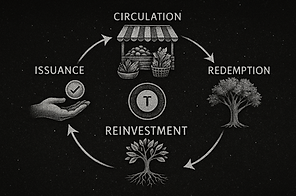
The diagram shows a simplified flow: Issuance of tokens by the community treasury, Earning by members through work or contributions, Circulation as tokens are exchanged for goods/services, Use/Utility where tokens fulfill needs or confer rights (e.g., spending in markets, staking in governance), and Redemption or Retirement where tokens exit circulation (via burning, conversion, or reinvestment into long-term assets).
A dashed arrow (“Reinvestment?”) loops back, indicating that value from redeemed tokens (like proceeds from selling regenerative credits externally) is fed back into the system to issue new tokens for future projects. This cycle ensures the currency is backed by real value – labor and ecological health – rather than speculation. It also highlights feedback: if too many tokens chase too few goods, the community can tighten issuance; if huge regen successes happen, they can expand the economy. The Terra Pact token system essentially internalizes what capitalism externalizes (labor and environment), making the economy a subsystem of society and nature, not the other way around.
Real-world analogs to parts of this system exist. The Sardex in Sardinia demonstrated a successful mutual credit network among businesses, enabling “€50 million per year of trades” and supporting the local economy without Euros . On the other hand, projects like Regen Network and carbon crypto markets are trying to tokenizes eco-credits. Terra Pact combines these ideas in a holistic way. It addresses the challenge that purely local currencies face: liquidity and relevance in a global context. By networking the currencies and tying them to regenerative metrics, Terra Pact hopes to create a stable yet adaptable economic system that rewards positive-sum behavior (everyone benefits from regeneration).

Governance of the Economy: The monetary policy – how many tokens to issue, etc. – is governed by the community via DAO proposals. In line with liquid democracy, those with more expertise in economics can earn delegated authority, but major changes require consent of the members. They likely simulate scenarios in sandbox models or consult token engineers (perhaps collaborating with like-minded crypto Commons projects globally). The idea is not to have a few techies secretly controlling the currency, but to make tokenomics a participatory science.
Educational efforts ensure that even non-experts understand the basics (e.g., workshops on “how our mutual credit works” or “what is a bonding curve in plain language”). This demystification is part of the decolonial approach – demystifying money, a tool historically used to dominate, and reclaiming it for community purposes.
To better understand the lifecycle of a token in this system, consider the journey of a Terra labor token:
1 → Issuance:
The token is issued by the community DAO, typically as payment for work or as credit for a needed purchase. For example, the DAO might mint 50 tokens to pay a team building a new wind turbine on the farm (effectively translating their labor into tokens).
2 → Earning:
A community member earns that token by doing the work or contributing resources. Now the token is in circulation with that member.
3 → Circulation/Use:
The earner can spend the token within the colony – perhaps at the community kitchen for meals, or to barter with another member for a jacket they made, or contribute it to a mutual aid fund (donations to someone who is sick). The token moves around, facilitating trade in the local marketplace. It might also travel to another colony – e.g., spent at a regional fair to buy handicrafts from a neighboring colony.
4 → Redemption/Conversion:
At some point, that token may be redeemed or converted. Perhaps the local DAO allows citizens to redeem labor tokens for a share in a big asset (like housing rights) or for external currency if the colony has exports. Or the token is returned to the DAO as part of a tax or community contribution (say each member contributes 5 tokens monthly to a commons fund). When redeemed or taxed, the token might be burned or put in reserve, effectively removing it from circulation.
5 → Recycling/Reissuance:
Based on need and ecological indicators, the DAO issues new tokens to new projects or for seasonal basic income distributions, etc., thus continuing the cycle.


Cross-Colony Exchange Protocol: Terra Pact colonies each have their local tokens/credits, but they need to trade across regions (say olive oil from one for wheat from another). Instead of forcing all to use one central currency (which could become a power instrument), Terra Pact designs a protocol for interoperation. It’s akin to how different local currencies or mutual credit systems can be linked through a clearinghouse or trust network.
Practically, they establish a Common Exchange DAO at the regional and global levels: this DAO maintains exchange rates between local tokens, based on community agreements and backing assets.
For example, the Anatolia colony’s labor token might be agreed to equal the Mediterranean colony’s labor token since an hour of work is an hour of work, but if needed they can adjust for purchasing power differences (maybe a factor if one region is more productive). The exchange DAO could use a mutual credit clearing – if Anatolia owes Mediterranean 100 token-units for goods, and Mediterranean also owes Anatolia some amount, it nets them out periodically and only balances the difference with a transfer.
Another approach is each colony accepting others’ tokens via green bonding curves: if all tokens are backed by regeneration value, there’s a common reference. They might float a network-wide token (call it Pact Token) that is minted only when a colony locks some of its own tokens as collateral along with proving a regenerative achievement. This Pact Token is then universally accepted across colonies for inter-community trade, essentially functioning as a mutual currency that represents a basket of local currencies and ecological assets. The design is complex but the idea is to have liquidity and unity without centralization – no single colony controls the currency issuance for all, but all adhere to shared protocols.
In daily life, what this means is a trader from Colony A can travel to Colony B and not worry if their labor tokens will be accepted – an app on their device will perform the conversion via the exchange DAO seamlessly. Or colonies can pool funds for joint projects (like a regional solar farm) by contributing their local tokens into a smart contract that issues shares in the project back to them.
Circular Economy and Redemption: Unlike fiat money that is infinite, Terra Pact tokens have intentional sinks and redemption options to prevent unchecked accumulation. For labor tokens, the sink might be that they can be redeemed for goods in community warehouses or time from specialists – once spent, they circulate back to the earners.
Governance tokens might periodically expire or require renewal (forcing even respected members to stay active to maintain influence). Eco tokens could be retired when sold outside the community as carbon offsets – essentially converting into fiat that funds the community, but then those particular eco tokens are burned, so the colony must generate new ones through further regen work.
They also practice demurrage on the currency: a small holding fee that encourages people to use tokens for productive exchange rather than hoard. This idea, inspired by Silvio Gesell’s theories, means if you sit on a pile of tokens doing nothing, they slowly lose value (or a portion is reclaimed to the community fund). It nudges continuous flow, reinforcing that this economy is about meeting needs and fueling projects, not accumulation for its own sake.

Challenges and Open Questions:
Designing such an economy has pitfalls. How to prevent exploitation or inequality?
Terra Pact caps how many labor tokens one can hoard – after a certain point, excess is automatically funneled into community projects or given as scholarships to youth.
What about interactions with the outside capitalist economy?
The colony still needs to pay for some external goods (solar panels, electronics, medicines) in conventional money. They achieve this by exporting certain regenerative products (organic spices, artisan goods, carbon credits) or by receiving solidarity funding from allies. It’s an ongoing negotiation to avoid dependence.
There’s also the risk of techno-solutionism: tokens and smart contracts won’t automatically create utopia; they require healthy social relations to have meaning. Terra Pact members remain aware that trust is their true currency – the tokens only symbolize it. Thus, constant community dialogue and democratic control are maintained to adjust the system if it isn’t serving the people.
In essence, the tokenomics is an evolving art, one that challenges the future of economics: can we build economies that regenerate rather than extract?
Terra Pact doesn’t claim to have the final answer, but it is charting a bold path to find out.
Cultural Practices and Decolonial Ethos
Beyond structures, technologies, and tokens, what truly binds the Terra Pact colony is a rich tapestry of culture and shared values. As a Global South-driven initiative, the colony deliberately cultivates practices that resist colonial legacy and uplift indigenous and local traditions. Culture is seen as both glue and compass: it maintains solidarity across diverse communities and points the way toward the decolonial futures the Terra Pact hopes to embody.
At Nowruz, communities gather to light a bonfire (an old custom symbolizing light over darkness), and around it they might share stories of their ancestors, recount struggles against oppression, and state intentions for the coming year. These storytelling circles serve as a ritualistic debrief and envisioning, reinforcing continuity with pre-colonial cultural heritage and the ongoing struggle for autonomy.
Another ritual might be the “Decolonial Assembly” held on significant dates (perhaps the anniversary of a local anti-colonial victory or an international day of indigenous peoples). In these assemblies, members symbolically “bury” something representing colonial influence – e.g., they might literally compost old textbooks that glorified imperial history, or perform a skit satirizing corporate bosses. This catharsis is paired with “seeding” new narratives: planting a tree to mark a new agreement or singing a collective song composed with lyrics about freedom and earth. Through such rituals, psychological liberation is pursued alongside the material projects.

Many Terra Pact colonies include diaspora and people of multiple backgrounds, so they consciously practice cultural exchange without hierarchy. One community might adopt the use of circle dance from another as a means of bonding, or incorporate call-and-response chants common in African movements into their meetings. The key is an attitude of celebration rather than appropriation – crediting and honoring the source cultures and finding commonalities. Over time, a Terra Pact culture emerges, distinct but ever-evolving, characterized by reverence for the Earth, egalitarian ethos, and a tapestry of Global South influences.
Seasonal Assemblies: The colony’s calendar is punctuated by large seasonal gatherings that serve both practical and cultural purposes. For instance, every solstice and equinox might be an occasion for a Regional Assembly. These are multi-day events where members from various local colonies in a region travel (often on foot, bicycle, or shared electric vans) to converge in one location.
One season it might be hosted by a coastal community, the next by a mountain village. These assemblies have a carnivalesque atmosphere – part festival, part conference, part marketplace.
During daylight, they hold councils and skill-shares. Circles discuss inter-colony projects (like coordinating water sharing for summer or planning a joint reforestation drive). Workshops happen under tents: herbal medicine making, storytelling, conflict resolution training, new tech demos (like how to build a wind turbine from scrap). In the evenings, cultural exchange takes center stage: each colony presents something – a play, a dance, a music performance, or a feast of local foods – effectively multimedia storytelling to share their experiences.
These seasonal assemblies coincide with natural cycles – e.g., a Harvest Assembly around autumn equinox where communities bring excess produce to trade and have communal feasts, aligning with traditional harvest festivals across cultures (from Thanksgiving analogs to Erntedank to Mehregan). A Planting Assembly in spring might involve collective ceremonies of sowing seeds together in a common field, symbolizing hope and shared effort. By rooting major meetings in seasonal rhythms, Terra Pact ensures that their high-level coordination stays grounded (literally) in the earth that sustains them.
Notably, the assemblies are opportunities for direct democracy at a large scale. Important decisions that affect everyone (like adopting a new principle or forging an alliance) are often saved for these in-person gatherings where trust and understanding are strongest. Through facilitated large-group processes (using techniques like Open Space and World Café), even hundreds of participants can contribute. The seasonal timing also means decisions benefit from a rhythm of reflection – an idea can be proposed in one assembly, tested on a small scale over a season, and then revisited in the next assembly with learnings.

Storytelling and Media: Storytelling is considered a vital craft in Terra Pact. Each colony has designated storytellers or documentarians who capture the community’s journey in various media. They produce short films, podcasts, zines, or even mural art that tell the tale of their struggles and innovations. This serves a dual purpose: internal learning and external outreach. Internally, sharing a story of how one village overcame, say, a water shortage by reviving an old irrigation method inspires others and builds a shared narrative of capability.
Externally, these stories counter dominant media narratives that might dismiss such colonies as naive utopias or threats. Instead, Terra Pact publishes its own media on decentralized platforms (using that mesh/internet connectivity) – essentially controlling its narrative. For example, they might run a “Terra Pact Radio” streaming channel that broadcasts interviews with farmers, poets, and technologists in the movement, as well as music from their cultures.
Multimedia storytelling also includes myth-making in a positive sense. They craft new myths that fit their values – perhaps a fable about a pact between humans and Terra (Earth) that all colonies uphold, giving almost a spiritual significance to their alliance. These myths and stories are retold at gatherings, in schools (many colonies homeschool or run their own academies), and in digital forums, creating a cultural continuity that transcends one location.
To further cultural exchange, Terra Pact organizes something akin to “culture caravans.” Small groups travel from one colony to another, carrying songs, stories, and crafts with them. For instance, a group of musicians might travel from a Lebanese colony across to Tunisia, stopping at Terra Pact sites along the way to perform and teach a song, while learning a local song at each and carrying it forward. By the end of the journey, that caravan’s repertoire is a blend of all regional influences – a musical embodiment of the Terra Pact mesh.
Solidarity Actions: Solidarity in Terra Pact is not just internal; it extends to supporting other oppressed or marginalized communities. They maintain a practice of rapid solidarity response: if a Terra Pact community is attacked (by paramilitaries, or hit by disaster), others mobilize support within hours.
This could be online campaigns, protests at embassies, fundraising, or even physical presence. For example, if a North African agroecology cooperative (not yet part of Terra Pact formally) is facing eviction by a corporation, Terra Pact media amplifies their story globally, and nearby colonies send people to stand with them or offer land for displaced farmers.

Education and Futurity: Culturally, Terra Pact invests in educating its youth with the movement’s values. Children grow up learning multiple languages of the region (reflecting diversity), learning about colonization and decolonization in truthful terms, and also getting hands-on skills (from farming to programming) – a very holistic curriculum. They are encouraged to question and innovate, ensuring that Terra Pact is not static. Youth councils give the younger members a voice in governance and cultural life, preventing stagnation or gerontocracy.
One might witness at a festival a group of teenagers debuting an experimental solar-powered music genre, or presenting a play about a future Terra Pact colony on Mars (playfully pushing the boundaries of the vision). The culture is future-oriented as well – challenging the future direction of technology and society. They ask themselves hard questions: how will AI be kept ethical? Could Terra Pact principles be applied in cities at scale?
What happens if our movement grows too successful – how to avoid becoming the new elite? These reflections are expressed in their art and discussions, keeping a healthy self-critical tone that guards against zealotry or complacency.
Open-Ended Ethos: While Terra Pact is determined in its mission, it resists any dogma or finality. There is no single holy book or rigid manifesto. Instead, there is a living manifesto that gets updated at seasonal global assemblies. They treat their colony like a living organism or a garden – something to tend and adapt rather than a machine to just run. This openness can be seen in cultural humor: they make jokes about their own experiments (“remember the solar drone fiasco of ’30!”), they allow space for dissent (art collectives that even critique Terra Pact decisions are allowed and heeded), and they ensure no practice becomes untouchable. As one elder states, “We are building the road by walking – and dancing – upon it.” The tone is hopeful yet humble: they know they don’t have all answers and that the world around them (political, ecological) can change fast.
In conclusion, the cultural practices of Terra Pact serve to decolonize the mind and social relations, fostering a new identity that is neither utopian fantasy nor cynical survivalism, but a grounded, evolving experiment in living differently. By ritualizing their values, celebrating diversity, sharing stories, and standing in solidarity, the Terra Pact colonies generate the social cohesion needed to sustain their ambitious governance, farming, and technology initiatives. The ethos is anti-elite – leadership is collective and rotates; and culturally rooted – they draw power from the rich heritage of their peoples and the seasons of their lands. It is a culture of resistance and renewal: resisting the old systems of domination, and renewing community and Earth for future generations.
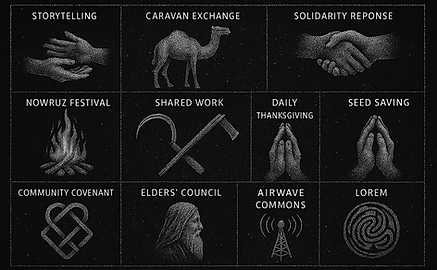
This echoes the Zapatista concept of “todos somos uno” (we are all one) and the anarchist mutual aid tradition.
Indeed, Terra Pact sees itself in lineage with movements like Zapatistas and Rojava, adopting the principle that an injury to one is an injury to all.
Across colonies, they have days of action – perhaps a Global South Solidarity Day where all colonies do some public act of solidarity (rallies, statements, art installations) for a cause, like Palestinian freedom or climate justice. These acts reinforce that Terra Pact’s struggle is part of a wider tapestry of global struggles. Culturally, it prevents insularity; members feel they are citizens of the world and history, not just their hamlet.
Internally, solidarity also means care systems. If one member is sick, others contribute labor tokens to support them. If one colony lacks a certain expertise, people from another colony volunteer to spend a few months there to help train locals (like a time exchange program). There is a strong ethos of “no colony left behind.” This was seen, for instance, when a severe drought hit one cluster; other clusters shipped tons of food and helped them build better water infrastructure for the future. Such stories become part of Terra Pact lore, told to new generations to inculcate the value of collective care.
Conclusion
The Terra Pact colony across Anatolia, the Middle East, and the Mediterranean, as depicted, is a speculative vision – yet it is built on real seeds present today:
DAOs experimenting with governance, farmers restoring land, community networks bridging digital divides, alternative currencies empowering locals, and peoples reclaiming their cultures. This essay has woven these threads into a cohesive scenario, balancing on the line between imagination and reality. The design is intentionally open-ended. It does not claim that technology will solve all problems; rather, it challenges us with new questions:
→ Can decentralized governance truly scale without falling into chaos or new forms of hidden hierarchy?
→ Will regenerative agriculture be enough to feed everyone in hard times, and can hi-tech tools remain under peoples’ control?
→ How will mesh networks and encrypted systems hold up against the brute force of state repression or corporate co-option?
→ Can a token economy avoid replicating the injustices of the old economy, or will human greed find a way?
→ And importantly, how does a movement maintain its cultural soul as it grows?
The Terra Pact invites us to ponder these questions, not in theory alone, but through praxis – through the very attempt of building such colonies. It stands as a speculative beacon: not a utopia, but a living laboratory where the future is being negotiated collectively.
In a world facing ecological crisis, social fractures, and authoritarian resurgence, the Terra Pact story is one of hope through federation, regeneration, and cultural resurgence.
It leaves us with an image: a network of village lights spread across the night map, each autonomously shining, yet linked by the faint glow of shared communication lines and the rhythms of shared ceremonies – a constellation of communities navigating by their own stars, together composing a new sky.
The journey of Terra Pact is just beginning, and its ultimate impact remains unwritten – a reminder that another world is possible, if we are willing to imagine and create it together.


